
Operating a food truck comes with many delicious challenges, and understanding your tax obligations is one of them. If you’re an aspiring food truck operator or a curious tourist in Lakewood, grasping the requirements of Form 1125-A can seem daunting. This form, associated with reporting costs of goods sold, may be a key part of your financial reporting, especially depending on your business structure. From sole proprietorships to corporations, knowing under what circumstances you’ll need to fill out this form can help you start your food truck journey on the right foot. Let’s explore the ins and outs of Form 1125-A and how it relates to our local food truck scene, making sure you’re well-equipped for this tasty adventure.
Counting the Tastes Behind the Cart: Do Food Trucks File Form 1125-A for Cost of Goods Sold?
The curbside kitchen on wheels is a study in lean operation. A food truck turns a handful of ingredients, a splash of spice, and a dash of technique into meals that travel across neighborhoods, festivals, and office parks. Yet the same nimble business model that makes these ventures exciting also makes the financial side of the enterprise intricate. At the heart of that complexity sits a basic question many operators ask: how do we account for the costs tied directly to the goods we sell? In tax terms, that question centers on the Cost of Goods Sold, or COGS. For some trucks, COGS is a deduction that travels with them from the kitchen to the tax return. For others, the road to that deduction runs through Form 1125-A, Cost of Goods Sold. The distinction hinges on how the business is structured and whether it reports inventory or other costs tied to producing the food sold to customers.
Form 1125-A is not a universal filing requirement for every food truck. Its use depends on the entity type and the specific tax form the business files. If a truck operates as a sole proprietorship and reports COGS on Schedule C (Form 1040), the driver’s seat of the return, the IRS generally does not require attaching Form 1125-A. The Schedule C approach combines gross receipts and COGS directly on the individual return. But once the enterprise takes a more formal corporate or partnership form—such as an S corporation filing Form 1120-S or a partnership filing Form 1065—and claims a deduction for COGS, Form 1125-A becomes the vehicle for detailing how that COGS figure is calculated. The IRS listing of forms that trigger 1125-A when COGS is claimed explicitly mentions Forms 1120, 1120-S, 1120-F, 1065, and 1065-B as examples. In other words, the question is not whether a truck sells food; it is whether the business uses an accounting framework that treats COGS as a separate deduction that must be supported by a dedicated form.
Smaller, operator-owner trucks that stay under Schedule C may still manage inventory in a simplified way. They may track ingredients, beverages, and packaging in a straightforward ledger or spreadsheet and subtract those costs from revenue on Schedule C. But when the business grows more formal—adding partners, investors, or a corporate veil—the mechanics change. A partnership reports through Form 1065, and an S corporation through Form 1120-S. In those cases, the IRS expects Form 1125-A to accompany the return when COGS is claimed. The purpose is not to complicate the process for its own sake, but to ensure that the calculation of COGS is transparent, auditable, and aligned with the actual flow of goods from procurement to production to sale. For operators evaluating their structure, this distinction matters not just at tax time but in how they organize finances, inventory, and production processes throughout the year.
What counts as COGS for a food truck? The Form 1125-A instructions describe a COGS line that begins with beginning inventory and adds purchases of inventory during the year. Direct labor costs tied to production are included, as are other direct costs associated with making the product. In a food truck context, that often means the raw ingredients like proteins, vegetables, grains, sauces, beverages, and even the packaging used to serve the product. If the truck holds inventory at year-end, ending inventory reduces COGS; if not, the ending inventory is zero, and the calculation is simply the sum of beginning inventory and purchases minus ending inventory. While these basics sound straightforward, the challenge is ensuring accurate tracking of what qualifies as inventory, what costs are direct, and how to allocate shared costs that touch multiple menu items. The form’s framework is designed to separate the costs tied directly to the product from other business expenses that are more related to running the business rather than producing goods for sale.
The practical application of the 1125-A framework hinges on how the business is organized and how it tracks costs. For a food truck operated as an S corporation or a partnership, the form is used to substantiate the COGS deduction. The numbers flowing into 1125-A should reflect the real operations of the truck: inventory quantities on hand at the start and end of the year, purchases of ingredients and supplies, and direct labor costs tied to preparing the food for sale. For an operator who buys flour, meat, produce, napkins, cups, lids, and other supplies, those items are not merely expenses. When they are part of a starting inventory or purchases that contribute to the cost of goods sold, they become aliquots of COGS. The distinction between inventory and non-inventory purchases can be subtle in the mobile setting. A sauce batch made for multiple menu items might involve direct costs that span several recipes. In that case, careful allocation is essential to prevent misclassification and to ensure COGS reflects actual production activity rather than a generalized expense. For readers who want to explore the material more concretely, consider seeking practical examples and guidance on how to map costs from kitchen to paper, a process that aligns with the realities of running a mobile food business.
In many communities, operators are also thinking about how to present their business structure to lenders or investors. An operator-friendly approach is to model the costs with robust inventory controls and clear cost allocation methods. The internal discipline of tracking inventory and direct labor unwraps the complexity of COGS. A well-kept inventory ledger helps when it is time to fill out Form 1125-A, even if the business ultimately files a Schedule C. The choice of internal systems can also influence how the truck schedules its production and procurement. It matters not only for tax compliance but for operational efficiency. A link in practice to explore how operators size up equipment and setup for efficient production can be found in discussions about startup-friendly truck configurations, such as the planning that goes into choosing a platform that balances capacity with mobility. For readers seeking real-world context on how mobile food ventures manage practical considerations, a helpful example can be found in the discussion of startup-oriented truck models. See the article on best food truck models for Lakewood startups, which offers a lens into how equipment choices influence kitchen workflows, inventory control, and ultimately cost management. best food truck models for Lakewood startups.
Beyond the numbers, the decision to use Form 1125-A interacts with how a business handles record-keeping and compliance. Preparing 1125-A requires careful documentation of beginning inventory, purchases, and direct costs; it also requires accurate calculation of ending inventory. For a mobile operation, that can mean tangible measures: keeping track of what inventory exists on the truck at year-end, what was received during the year, and what was used to prepare items sold on the curb. It also means maintaining supporting documents such as purchase receipts, supplier invoices, production records, and payroll records assigned to production activities. The distinction between direct labor and indirect labor becomes essential here. Direct labor costs are those tied to the actual preparation of the food—hands-on cooking, assembling meals, and any labor that can be directly traced to producing the goods sold. Indirect labor, which supports but does not directly produce the goods, does not belong in COGS unless the costs can be allocated directly to specific products. This allocation becomes a practical methodology for operators to implement as they categorize expenses during the year and prepare for tax reporting.
A key takeaway for owners is that Form 1125-A is not merely a box to check. It is a structured framework that pushes the operator to align the accounting records with the realities of the production process. If a truck has a robust inventory system, identifies direct costs, and can allocate labor and materials to specific products, 1125-A becomes a natural extension of that discipline. If, however, a food truck is run more as a straightforward service operation with minimal or no inventory, the form may not be necessary. In such cases, COGS can be tracked and claimed in other parts of the tax return, consistent with the form and the IRS instructions for that specific structure. The difference affects not only tax filing but the clarity of the business’s financial picture throughout the year. In the wider arc of the article, this nuance underscores a broader theme: the tax treatment of COGS mirrors the structure of the business and the degree to which inventory and direct production costs are integrated into daily operations.
For readers who want a firm anchor in official guidance, the Internal Revenue Service provides the authoritative source for Form 1125-A. The instructions detail how COGS is computed, what counts as inventory, and how to report the figures on the appropriate tax forms. It is prudent to review these instructions or consult a tax professional to ensure that the treatment of COGS aligns with the current rules and the specifics of the business. The official resource is available at the IRS website: https://www.irs.gov/pub/irs-pdf/i1125a.pdf. This reference remains a touchstone for operators who must decide whether 1125-A is required and, if so, how to prepare the form accurately over the course of a year of sales and purchases.
In sum, the question “Do food trucks use Form 1125-A for reporting costs of goods sold?” has no one-size-fits-all answer. It hinges on the entity structure and whether the business claims a COGS deduction. Sole proprietors using Schedule C often do not file Form 1125-A, while partnerships and corporations that claim COGS typically do. The form’s emphasis on beginning and ending inventories, purchases, and direct costs aligns with the way a mobile kitchen creates value from raw materials. For operators, the practical implication is clear: invest in solid inventory and cost-tracking practices, understand your business structure, and seek guidance when your tax return moves beyond the simplest schedule. In the end, the alignment of operations with accounting and tax reporting is not merely a compliance exercise; it is a disciplined approach to understanding how the costs of the goods you sell drive your profitability, curbside and beyond.
External resource: For an authoritative overview, consult the IRS Form 1125-A Instructions here: https://www.irs.gov/pub/irs-pdf/i1125a.pdf
Inventory, Profit, and Policy: Decoding When Food Trucks Must File Form 1125-A
COGS, or cost of goods sold, sits at the heart of a food truck’s profitability. For many operators, especially those who run as sole proprietors or keep a lean fleet under a partnership or an S corporation, inventory and how it feeds the bottom line are not just bookkeeping details — they shape tax reporting in a concrete way. Form 1125-A, Cost of Goods Sold, is the instrument the IRS uses to ensure that the cost of the materials used to produce sold goods is captured accurately. Yet not every food truck must file Form 1125-A. The obligation depends mostly on how the business is structured and whether it claims a deduction for COGS on the returns it files.
COGS covers the costs tied to the goods that are consumed in producing the menu items sold during the year. For a food truck, that typically includes ingredients such as buns, vegetables, proteins, sauces, and other supplies, as well as the packaging used to present the finished product. When a business tracks these items as inventory—inventory that has a beginning balance at the start of the tax year and an ending balance at year’s end—the COGS deduction becomes a running calculation: Beginning Inventory plus Purchases minus Ending Inventory plus or minus adjustments. The Form 1125-A is designed to capture that calculation because it becomes part of the calculation of gross profit and, ultimately, net income. In practice, inventory tracking might be as simple as a spreadsheet that tallies stock on hand, or as sophisticated as an integrated inventory system that updates in real time as orders come in. Either way, the IRS expects a consistent method for determining what portion of the year’s revenue is tied to the goods sold and what portion must be charged to the items consumed to produce those goods.
Not all food trucks maintain inventory in the sense of counting material on shelves, however. A sole proprietorship filing Schedule C (Form 1040) generally does not attach Form 1125-A, because it does not report COGS on the tax return in the same way that a partnership or a corporation does. But when the business is organized as an S corporation (filing Form 1120-S) or as a partnership (filing Form 1065) and the owner or the entity claims a deduction for COGS, Form 1125-A becomes the mechanism to document those costs. The crucial threshold is not simply owning inventory, but reporting a COGS deduction on a return that corresponds to a tax classification requiring Form 1125-A. In other words, inventory matters, and how it is accounted matters, for the purpose of the form that captures the cost of that inventory as part of gross profit.
Consider a hypothetical but representative scenario: a food truck purchases buns, vegetables, dairy, sauces, and other supplies in bulk, stores them, and uses portions of these items to prepare menu items. At year-end, the business has a tally of what remains on hand. If the venture is structured as an S corporation or a partnership and the owners claim COGS, Form 1125-A must be filed to report the cost of those goods sold during the year. If the food truck operates as a sole proprietorship filing Schedule C, the owner might still track COGS, but the form attachment changes: there is no Form 1125-A in that scenario. The distinction matters because it affects how revenue is translated into taxable income and, by extension, how much tax is owed. The act of maintaining inventory is not merely a cost-control habit; it is a tax reporting decision that can swing the numbers on the return, depending on the entity type and the method chosen for accounting.
Beyond the mechanics of the form, there is a risk landscape that operators should respect. Misreporting COGS, omitting an inventory line item, or failing to attach Form 1125-A when the business structure requires it can trigger penalties or draw IRS scrutiny. The instruction manuals for Form 1125-A lay out the expectations clearly: when inventory exists and COGS is claimed, the form accompanies the return. Even if a business uses the cash method of accounting, the presence of inventory in the operation generally keeps 1125-A on the table. For operators juggling multiple ventures or a growing fleet of carts, this means establishing reliable inventory controls from day one and choosing an accounting method that aligns with the business model and the tax reporting obligations.
To the reader seeking practical navigation, it helps to connect the tax requirements with the broader business planning. Inventory management isn’t just about reducing waste—it’s about creating a transparent picture of the costs embedded in every bite. When assessing whether Form 1125-A applies, consider who files which form and whether COGS is being claimed on that form. For instance, if a venture is structured as an S corporation or a partnership and the owner expects to deduct cost of goods sold, Form 1125-A is the canonical path to report those costs accurately. In such cases, the narrative of the business is not simply revenue generation; it is a ledger of the ingredients, the sourcing decisions, the yields, and the price points that together reveal true profitability. This is where the discipline of inventory tracking pays off beyond the balance sheet: it clarifies how much of each dollar earned reflects the productive input of raw materials rather than service fees or other expenses.
Finally, for readers who want a direct line to the practical side of planning, consider how inventory and reporting intersect with the broader strategy of starting or growing a food truck operation. The choices about structure, accounting method, and inventory controls will ripple through the tax process and shape financial projections. If you are exploring fleet designs and operational models, there are resources that help illuminate how different configurations influence cost structures and profitability—for example, see the guide on Best Food Truck Models for Lakewood Startups. This material can help you think through the implications of scale, procurement, and inventory discipline in the context of tax reporting, even as the core issue remains the accuracy of the cost of goods sold calculation.
Official guidance on Form 1125-A remains essential reading for any bustling food truck that keeps track of inventory. While the general principle is straightforward—COGS must reflect the cost of goods consumed to generate revenue—the details of what counts as inventory, how to value it, and when the form must be attached are the kinds of specifics that vary with jurisdiction and filing category. To ensure compliance, consult the IRS instructions and consider consulting a tax professional who understands the dynamics of small food-service businesses. The form instructions available through the IRS site provide the framework for determining whether Form 1125-A applies to a given entity and situation, and they spell out the documentary requirements for supporting schedules, line items, and calculations that translate stock on hand into taxable figures. For official guidance, refer to the IRS Form 1125-A Instructions. IRS Form 1125-A Instructions.
Tax reporting is not a standalone discipline; it is nested in the broader questions of business design, supply chains, and customer experience. The decision about whether a food truck files Form 1125-A ties into how inventory is treated, how purchases are tracked, and how profitability is communicated to lenders, partners, and regulators. When done well, inventory accounting aligns with the business’s actual operations. When done poorly, it creates a mismatch between what is earned and what is reported, inviting unnecessary audits or penalties. The most resilient approach is to begin with clear policies for inventory tracking, select the appropriate accounting method at the outset, and document COGS consistently on your tax return in a way that mirrors real-world procurement and usage. In that sense, Form 1125-A is not merely a bureaucratic requirement; it is a reflection of disciplined operations and transparent reporting.
Structure, Stock, and Sizzle: How a Food Truck’s Legal Form Determines Form 1125-A and the COGS Report
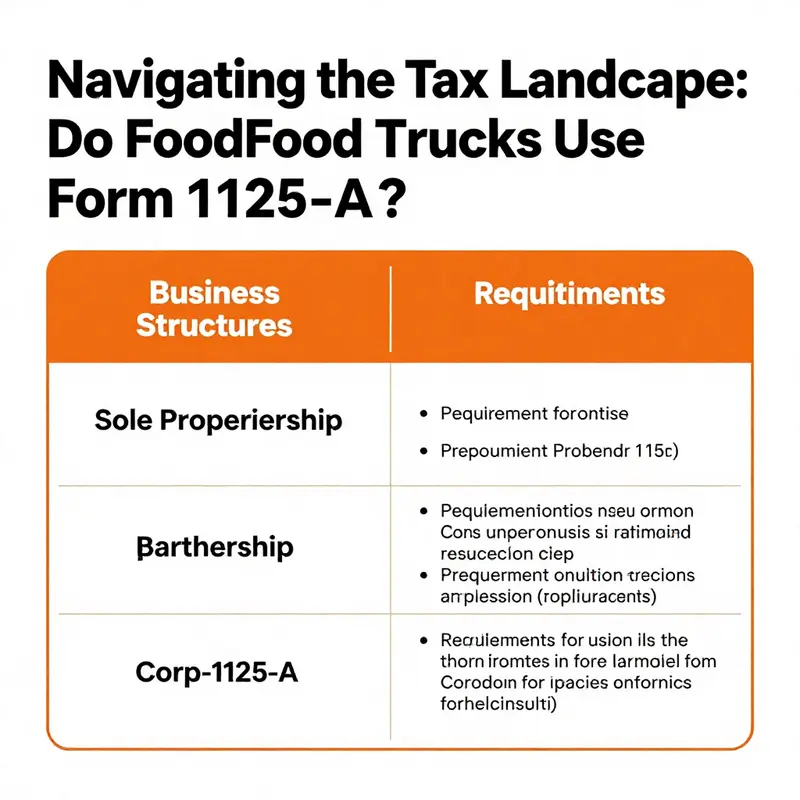
The question of whether a food truck should file Form 1125-A sits at the crossroads of taxation, business structure, and the daily realities of running a mobile kitchen. For operators who track inventory of perishables, packaging, and other supplies, cost of goods sold (COGS) isn’t just a line item at year-end; it drives true profitability and shapes tax reporting.
Form 1125-A, Cost of Goods Sold, is required for taxpayers who file specific corporate or partnership returns and claim a deduction for COGS. Those returns include Form 1120 for corporations, Form 1120-S for S corporations, Form 1065 for partnerships, and Form 1065-B for certain investment vehicles. In those contexts, the IRS expects a detailed accounting of what it costs to produce the goods sold during the year.
For a food truck, the twist is that many operators run as sole proprietors or single-member LLCs, where income and expenses flow through to a personal return. Schedule C (Form 1040) is the familiar vehicle for these owners, and in that configuration Form 1125-A simply isn’t filed. The same ingredients, invoices, and recipes flow through, but COGS is reported on Schedule C rather than on Form 1125-A.
If the business operates as an S corporation or as a partnership with inventory, Form 1125-A becomes a conduit for transparent COGS reporting, ensuring that the cost of ingredients, supplies, and packaging used to produce each sale is properly allocated and deductible, while aligning with the higher administrative standards that accompany corporate or partnership taxation.
The choice of structure determines whether 1125-A applies. A sole proprietor enjoys simplicity: a single tax return, simpler bookkeeping, and direct exposure to personal liability. An LLC can be taxed as a sole proprietor or as a partnership; if taxed as a partnership and holds inventory, Form 1065 with Form 1125-A may apply. If taxed as a corporation, Form 1120 or Form 1120-S could trigger 1125-A when COGS are claimed.
Operationally, the decision to pursue a formal structure drives record-keeping discipline that makes 1125-A practical. A business filing under Schedule C may still benefit from rigorous inventory controls, regular reconciliations, and vendor tracking. For S-corp or partnership paths, separate books, formal accounting, and regular inventory counts become necessary to satisfy IRS expectations when reporting COGS on Form 1125-A.
The mechanics of inventory begin with beginning inventory, purchases, cost of goods available for sale, and ending inventory, which map to kitchen-level processes: supplier invoices, stock checks, and recipe-level costing that a well-run food truck would recognize as routine.
Seasonality and mobility add nuance. A truck that operates year-round with steady supply chains may justify corporate or partnership planning to optimize tax outcomes and capital allocation. A truck that pivots between markets and keeps lean stock may favor simpler structures with lower overhead.
For readers planning ahead, consider inventory management, pricing, and capital allocation in structure discussions. If pursuing a formal strategy, imagine a path with structured operations manuals and regular reconciliations that support either 1125-A reporting or a straightforward COGS approach under Schedule C.
For further reference, see best food truck models for Lakewood startups and the Form 1125-A Instructions at IRS. https://www.irs.gov/pub/irs-pdf/i1125a.pdf
null
null
From Sizzle to Schedule: Unpacking the Tax Implications of Form 1125-A for Food Trucks
Behind every successful food truck is more than a flavorful menu and a well-timed delivery route; there is a precise tax framework that determines how much of the truck’s revenue actually becomes profit. For operators who file on forms that include a claim for cost of goods sold, Form 1125-A—Cost of Goods Sold—can shape the landscape of taxable income in ways that are not immediately visible at the window when a customer pays for a taco or a bowl. The form is not a universal requirement for every food-truck business, but it is essential for those organized as corporations or as partnerships where COGS deductions are claimed. In these cases, Form 1125-A provides the structured accounting needed to translate raw ingredients, packaging, and other direct costs into a measurable cost of goods sold. The result is a more accurate gross profit figure, which then feeds into the broader calculation of corporate or partnership tax obligations. Food trucks, with their lean operations and fast-moving inventory, can feel like they operate in a different tax reality, but the same rules that govern a storefront restaurant apply here, with a few twists shaped by business structure and accounting method.
The key distinction begins with business structure. If a food truck operates as a sole proprietorship, reporting usually happens on Schedule C of Form 1040, and Form 1125-A is generally not required. When ownership shifts toward more formal arrangements—an S corporation filing Form 1120-S, or a partnership filing Form 1065—the game changes. In these cases, if the business claims a deduction for cost of goods sold, Form 1125-A becomes the instrument through which that COGS is defined, itemized, and reconciled with the revenue reported on the main return. This alignment is not just a bureaucratic requirement; it is the mechanism by which the IRS ensures that the cost structure of a food truck’s menu, beverage offerings, and side items is accurately reflected in taxable income. Without 1125-A, deductions for COGS claimed on the underlying return could be challenged or disallowed, and the resulting tax liability could be higher than anticipated. The distinction is not merely academic: it affects timing, inventory accounting, and the way a truck family plans for growth.
At its core, COGS on Form 1125-A represents the direct costs tied to producing the goods sold by the business. For a food truck, those costs routinely include the raw ingredients—produce, proteins, spices—along with packaging such as containers, napkins, and utensils used to serve customers. It can also cover direct labor involved in cooking and preparation if that labor is specifically tied to making the sold goods. The regulatory language, and the accompanying instructions, define COGS with enough nuance to accommodate the realities of a mobile kitchen. Inventory accounting methods matter here. Under the cash method, some inventory costs may be treated differently than under accrual accounting, particularly when inventory exists at the beginning and end of a tax year. For many food trucks, cash-basis accounting is common during the early stages of a business; as growth occurs and more complex partnerships or corporate structures are formed, accrual accounting often becomes more appropriate to reflect the true timing of sales and expenses. This is where Form 1125-A intersects with practical operations: ensuring that inventory counts, supplier invoices, and purchase orders line up with the tax year in which revenue is recognized.
Consider a hypothetical food truck that generates $100,000 in gross revenue over a year and reports $40,000 in COGS. The gross profit, $60,000, becomes the starting point for the calculation of taxable income on the entity’s main return, after other deductions and adjustments are considered. If the business is an S corporation filing Form 1120-S or a partnership filing Form 1065, the $60,000 COGS figure flows through to the entity-level tax computation and then to the individual owners’ or partners’ returns, depending on ownership structure. This flow is a critical component of tax planning: it helps owners anticipate potential tax liabilities, align distributions with after-tax profits, and spot opportunities to optimize inventory management for the coming year. The mechanics are not glamorized in tax code, but they translate directly into cash available for payroll, equipment upgrades, or new truck acquisitions. In a landscape where competition in the street-food market remains intense, the precision offered by Form 1125-A can make a real difference in sustaining margins and funding growth.
Properly completing Form 1125-A requires disciplined documentation. The form invites a careful delineation of items that count toward COGS and those that do not. For example, while ingredients and packaging are typically included, indirect costs—such as general administrative salaries, marketing, or depreciation on a non-production asset—generally fall outside COGS. The IRS instructions emphasize the necessity of consistent inventory accounting methods, whether the business uses a periodic or perpetual inventory system, and how updates to inventory levels affect the COGS calculation. The choice between cash and accrual methods influences the timing of when certain expenses are recognized. Under accrual accounting, COGS is recognized when goods are sold, regardless of when payment is received, which can mirror the reality of a busy street operation where supplies may be bought in one month and delivered across multiple sales events. Conversely, with cash accounting, expenses are typically recognized when payment is made. The result is a tax profile that can shift with the accounting method and the timing of inventory purchases, a dynamic that many food-truck operators experience during seasonal peaks or new product launches.
The practical implication of these rules becomes evident in everyday management. Maintaining meticulous records—receipts from suppliers, invoices for ingredients, and counts of inventory on hand at year-end—is not just auditable formality; it is the backbone of an accurate 1125-A calculation. In a mobile business where the menu evolves with local supply, a well-run system for tracking inventory movements helps prevent overstatement or understatement of COGS, which could skew gross profit and, in turn, the tax outcome. This is particularly important when a business contemplates growth through additional trucks or partnerships. If a new partner or an additional S-corp entity is introduced, the corresponding Form 1125-A filings must align with new revenue and COGS data so that the tax picture remains coherent across filings. It is in these moments that the form becomes less of a compliance checkbox and more of a financial compass, guiding decisions about supplier negotiations, menu planning, and even the pace at which a business expands its fleet.
For operators who are weighing strategic options, there is value in recognizing how Form 1125-A integrates with broader business planning. A food truck’s profitability hinges not only on the revenue generated at the curb but also on how well COGS are controlled and reported. When COGS are effectively managed and accurately reported, gross profit better reflects the true performance of the selling activities, enabling smarter decisions about where to invest in better ingredients, more efficient packaging, or streamlined prep processes. If a truck owner contemplates adding a second or third truck, the consolidated tax picture becomes more complex, and consistent application of COGS across entities matters for a clear, auditable trail. In this sense, Form 1125-A supports prudent financial management by tying the operational realities of a mobile kitchen to the tax framework that governs corporate or partnership returns.
As readers consider the practicalities of implementing or refining Form 1125-A within a food-truck operation, they may also be curious about how these considerations intersect with equipment and startup choices. A related discussion on the realities of choosing a kitchen setup and the best startup models for lakewood-based ventures can offer useful context for balancing cost, efficiency, and scalability. For readers exploring that angle, see the articles on best-food-truck-models-for-lakewood-startups, which provide a grounded look at how upfront investment decisions influence ongoing cost structures and, by extension, the COGS they report on Form 1125-A. Such cross-referencing helps bridge the gap between tax compliance and practical operations, ensuring that the numbers on the form reflect an approach to business that is both sustainable and adaptable to changing conditions on the street.
In the end, Form 1125-A is not a standalone instrument. It sits at the intersection of inventory control, accounting method, and strategic planning. For food truck operators organized as corporations or partnerships, it provides the framework for translating the day-to-day costs of producing meals into a clean, auditable cost of goods sold figure. The accuracy of that figure influences gross profit, informs tax liability, and supports a business plan that can withstand scrutiny during tax season or an IRS review. The take-away is practical: keep receipts organized, count inventory consistently, choose an accounting method that matches your operating reality, and use Form 1125-A as a tool for meaningful financial insight rather than a formality to be checked off a filing deadline. As the street food landscape continues to evolve, the curveball of tax compliance remains predictable when approached with the same discipline that goes into delivering a consistent, high-quality meal from a moving kitchen.
External resource: IRS Form 1125-A Instructions (Rev. November 2024) — https://www.irs.gov/pub/irs-pdf/i1125a.pdf
Final thoughts
Navigating the complexities of tax obligations can feel overwhelming, especially for passionate food truck owners wanting nothing more than to serve delicious meals. Form 1125-A is an essential part of the financial puzzle for food trucks operating under specific business structures, allowing them to report their costs of goods sold efficiently. With the right understanding and a bit of preparation, you can not only ensure adherence to tax regulations but also keep your focus where it matters—on delighting customers and whipping up those tasty dishes. Always consult with a tax advisor to make sure you’re making the best choices for your unique food truck venture!